

Home energy costs rarely rise without warning. For most homeowners, the increase shows up gradually, month by month, until the utility bill becomes impossible to ignore. In nearly every case, the cause can be traced back to how hard the HVAC system is working to maintain indoor comfort. Heating and cooling equipment does not become inefficient overnight. Efficiency erodes slowly as airflow declines, components drift out of calibration, and wear accumulates across the system. Regular HVAC maintenance addresses these changes before they translate into higher energy consumption, making it one of the most reliable ways to control energy bills over the long term.
Heating and cooling account for a substantial share of residential energy use, particularly in regions where air conditioning operates for much of the year. When an HVAC system runs efficiently, it reaches temperature targets quickly and cycles off as designed. When efficiency declines, the system compensates by running longer and more frequently. That additional runtime directly increases electricity or fuel usage. Maintenance influences this equation at every level of system operation, from airflow and heat transfer to electrical performance and system controls.
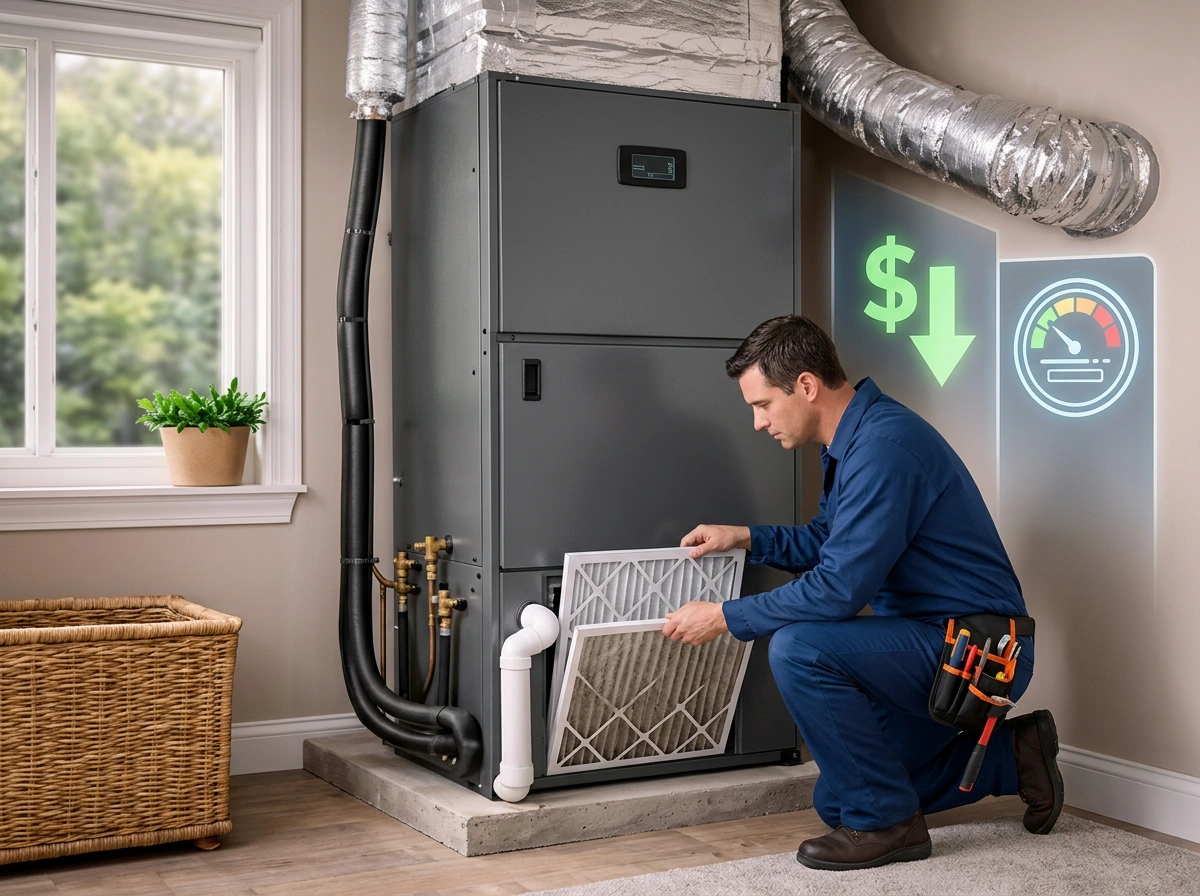
Airflow is the foundation of HVAC efficiency. Every system is engineered to move a specific volume of air across the evaporator and heat exchanger to support effective heat transfer. When airflow is restricted, heat cannot be absorbed or released at the intended rate. The most common source of airflow restriction is gradual buildup inside the system. Filters clog with dust, blower wheels collect debris, and internal surfaces become coated with residue from everyday operation.
Even moderate airflow restriction forces the system to work harder. Longer cycles are required to reach the thermostat setting, and those extended run times increase energy consumption. Motors draw more power, compressors stay engaged longer, and overall system efficiency drops. Routine maintenance restores airflow by replacing or cleaning filters, inspecting blower components, and removing obstructions before they impair performance. Once airflow is restored, the system operates closer to its original efficiency and requires less energy to maintain comfort.
Heat transfer efficiency depends just as heavily on cleanliness. The evaporator coil absorbs heat from indoor air, while the condenser coil releases that heat outdoors. Both processes rely on direct contact between air and clean metal surfaces. Dirt and grime act as insulation, slowing heat movement and forcing the system to compensate through longer operation. During professional maintenance visits, coils are inspected and cleaned as needed to restore proper heat exchange. This improves cooling performance and reduces the amount of energy required to move heat out of the home, particularly during periods of high outdoor temperatures.
Many of the most costly efficiency losses occur quietly, without obvious symptoms. Refrigerant performance is a prime example. HVAC systems are designed to operate with a precise refrigerant charge. When levels drop due to small leaks or improper servicing, efficiency suffers even if the system continues to cool. Low refrigerant levels reduce the system’s ability to absorb heat, forcing the compressor to run longer to achieve the same result. Over time, this increased workload drives up energy usage and accelerates wear on critical components.
Maintenance inspections include refrigerant pressure checks and performance testing that identify these issues early. Correcting refrigerant imbalances restores efficiency and prevents months or years of unnecessary energy consumption. Without routine maintenance, these problems often remain undetected until energy bills rise significantly or the system experiences a major failure.
Electrical performance also plays a major role in energy use. Components such as capacitors, contactors, motors, and wiring connections regulate how electricity flows through the system. As these parts age, resistance increases, and motors may draw more amperage than necessary. In some cases, worn electrical components cause erratic cycling that further increases energy consumption. Maintenance includes testing electrical components, tightening connections, and replacing parts that no longer operate within proper tolerances. These steps help ensure that the system uses power efficiently instead of wasting it through electrical losses.
Thermostat accuracy is another often overlooked contributor to energy waste. A thermostat that reads temperature incorrectly can cause the system to run longer than needed or cycle too frequently. Small inaccuracies may seem insignificant, but over the course of a season they can add noticeably to energy costs. During maintenance visits, technicians verify that thermostats are calibrated correctly and communicating properly with the system. Accurate controls allow the HVAC system to respond to actual indoor conditions, preventing unnecessary operation.
Beyond immediate performance improvements, regular maintenance preserves system efficiency over time. Mechanical systems naturally experience wear, but neglect accelerates that process. Bearings lose lubrication, belts loosen, motors drift out of balance, and airflow pathways degrade. Each of these changes increases the energy required to deliver the same level of comfort. Maintenance interrupts this progression by addressing small issues before they compound into larger inefficiencies.
Consistently maintained systems tend to retain performance closer to their original design specifications. Homeowners often notice this in the form of stable energy bills rather than the gradual increases common with poorly maintained equipment. By keeping components clean, aligned, and properly adjusted, maintenance slows efficiency loss and extends the usable life of the system.
Ductwork performance also affects long-term energy costs. Leaky or poorly sealed ducts allow conditioned air to escape into unconditioned spaces before it reaches living areas. This loss forces the system to compensate by running longer cycles. While full duct sealing may not be part of routine maintenance, trained technicians can identify airflow imbalances, pressure issues, or visible insulation problems during inspections. Early identification allows homeowners to correct these issues before they result in ongoing energy waste.
Comfort consistency further supports energy efficiency. A well-maintained HVAC system delivers even temperatures throughout the home and manages humidity effectively. When comfort remains stable, occupants are less likely to make frequent thermostat adjustments that drive up energy use. In humid climates, proper maintenance also ensures that the system removes moisture efficiently, allowing comfortable conditions at higher thermostat settings that consume less energy.
From a financial standpoint, regular HVAC maintenance reduces energy bills by preventing avoidable inefficiencies. Lower utility costs are often accompanied by fewer emergency repairs and longer equipment lifespan. These benefits share a common source: a system that operates efficiently instead of under constant strain. While energy savings may accumulate gradually, the long-term impact on household expenses is significant.
If controlling energy costs and protecting system performance are priorities, professional maintenance provides a clear advantage. Gulf Coast Heating & AC in Pinellas Park, FL, delivers thorough maintenance services designed to improve efficiency, reduce energy waste, and support reliable operation year after year. Contact us today to schedule service and take a practical step toward lower energy bills and dependable indoor comfort.
We are located here:

